#32. Mere anarchy is loosed upon the world

Well, shoot. It's been like six weeks since I sent out the last of these weekly newsletters, and while I would like to say that it's because I've been so busy, it's actually because I've just been so... not in the mood?
The thing is, in case you haven't noticed, the world is terrible. And speaking as someone with both an anxiety disorder and a political science degree, I feel a responsibility to keep an eye on the news. And, folks: what a friggin mess.
This is not to say that the world is ENTIRELY terrible. The Olympics are on, and nothing makes me more optimistic for the future of humanity than some good Olympics. (Did you see that cross-country skier who ran UP a hill, in skis, doing a six minute mile?? We should vote for that guy.)
But, I once lived in Minnesota, and I have friends in Minnesota, and things hurt right now. And that's just a notable spot where there are TV cameras--think of all the places where there aren't TV cameras. It's disheartening. To say the least. And, not intending to be the embodiment of That Poem, we have a family member who is in a marginalized group, and as we have watched the actions of the government, my wife, gravely, asked "Who are they going to come for when they're done with immigrants?"
So, yes, that poem. Which means we stand up now.
There's another poem that I quoted in a book—a very famous poem—but I've Emily been thinking about it a lot lately. (And, in the warning words of Brontë. "There's not a smile in it.")
Turning and turning in the widening gyre
The falcon cannot hear the falconer;
Things fall apart; the centre cannot hold;
Mere anarchy is loosed upon the world,
The blood-dimmed tide is loosed, and everywhere
The ceremony of innocence is drowned;
The best lack all conviction, while the worst
Are full of passionate intensity.
(Excerpt of The Second Coming, by William Butler Yeats)
And this is the part of the newsletter when I turn it around and say: but the moral of the story is: "always eat your vegetables and things will turn out fine." Or, whatever I say in these newsletters.
The best I've got today is this: as Buttercup and Wesley are running into the Pit of Despair, they say:
Buttercup: “We’ll never survive!”
Wesley: “Nonsense. You’re only saying that because no one ever has.”
And if you want something that is significantly more relevant, one need only look to Anne Frank herself:
“How wonderful it is that nobody need wait a single moment before starting to improve the world.”
In fact, that's why I'm writing this today, because I'm (trying to be) done wallowing in the awfulness of the world and want to make a contribution to improving it. And if the best I can do is to send out a newsletter, well, that's one tiny tear in the fabric of authoritarianism.
As I was writing this—like five minutes ago—I got an email from World Central Kitchen. That's the one that's led by Jose Andres, and they've now crossed a milestone where they are serving more than one million meals a day in Gaza. In their press release, which I only received this morning, Jose Andres said this:
“Today, we reached one million hot meals a day in Gaza. It’s not a statistic. It’s Palestinians feeding Palestinians, cooking with dignity under impossible conditions. It’s communities refusing to give up on one another. Today we honor this achievement—and tomorrow, we keep cooking. Because feeding people is the most basic act of humanity, and Gaza still needs the world to show up.”
SO WITHOUT FURTHER ADO: Here's what's been going on in the world:
(By the way, I think that's like the third sentence I've had so far that uses two colons.)
Bits And Bobs From the World

1. The Olympics are great, and the Winter Olympics doubly so—partly because they're so silly. The Summer Olympics are all about "Strongest and Fastest" and the Winter Olympics are "All the funny ways to go down a hill." AMYWAY: one sport that gets a lot of jokes thrown its way is curling, and I used to make such jokes until I took a curling class (at the Olympic stadium here in Salt Lake City after the 2002 Olympics) and I learned that it is, in fact, very very difficult. Silly? Sure. But slippery? Very.
ANYWAY ANYWAY: did you know that the stones used in curling are very regulated: they can only come from one of two places: a tiny island in Scotland called Ailsa Craig, or the Trefor granite quarry in Wales. (And all the Olympic stones come from Scotland.) This is partly tradition, but also because you need a very particular kind of granite: it has to be slippery, and it has to be able to whack into other stones without fracturing. And that means the stones need to be young (geologically-speaking). Ailsa Craig's stones are only 60 million years old—they're just babies!

2. In news that ISN'T about science: our esteemed Secretary of Health and Human Services, RFK Jr, said that a ketogenic diet can cure schizophrenia and bipolar disorder. Speaking as someone who has the schizophrenias (I have schizophrenia) here's the science: Well, for starters, in that news conference RFK Jr cited a Dr. Pollan at Harvard, and there is no Dr. Pollan at Harvard. There IS a Dr. Palmer, and in 2025 he co-authored a study that looked at ketogenic diets and mental health, and he said SOME people in SMALL trials saw help, but that it wasn't a substitute for medication. Scientific American interviewed Jeff Volek at the Ohio State University, who is a leading expert in ketogenic studies, and he said he "isn’t aware of any published clinical trial that shows the diet can cure schizophrenia."
“People following diets for health and wellness advice or even long-term cardiovascular health—it’s not at all the same thing as treating a serious brain disorder like epilepsy or schizophrenia,” Palmer says. “By no means would I ever want them to think that [a person with schizophrenia] can go wing it and just try a diet and cure themselves.”
So, anyway.
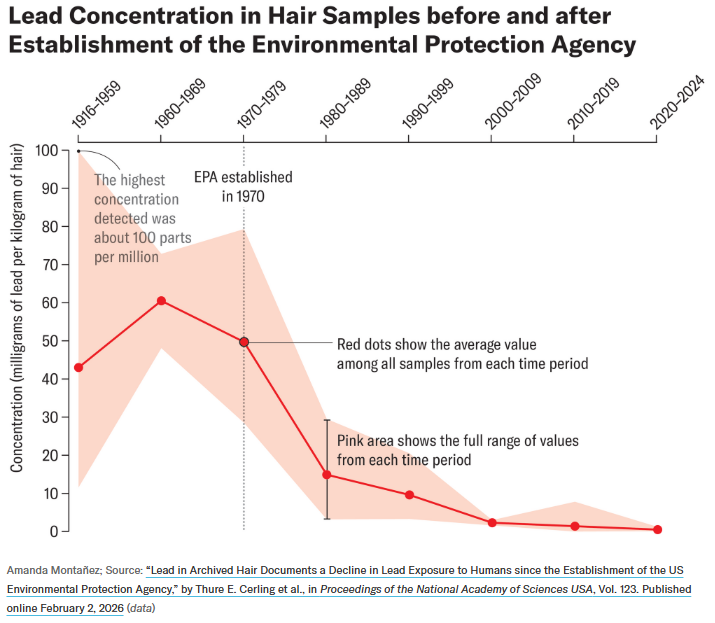
3. I live in Utah, and one of Utah's oddities made science news last week, when researchers at the University of Utah proved that exposure to lead has dropped by more than a factor of 100 since the 1960s. For those of us who are young--or even middle aged--it may seem weird that all our gasoline says "unleaded" but there was a big long stretch of time when we were putting lead into gas (and paint, and consumer products like makeup) and that lead would be absorbed into our bodies and lungs and it would make us crazy and violent. (No lie! There's a whole theory—the Lead-Crime Hypothesis—that posits that the sharp decline in violent crime around the 1990s was due to having less lead in our bodies!)
ANYWAY: The reason this has a Utah connection is that people in Utah, for religious and cultural reasons, like to do genealogy, and part of that is keeping baby books with clippings of babies' hair as well as their lost baby teeth. So, the researchers gathered hair samples from babies going all the way back to 1916, and examined it for lead.
"The trend over time is stunning. Peak lead rates occurred in samples from the 1960s, when lead was enriched by some 120 times compared with 2020–2024 samples. But since the 1960s, lead exposure rates steadily plummeted. The decline occurred alongside the formation of the Environmental Protection Agency in 1970 and the passage of landmark legislation, including the Clean Air Act and the Clean Water Act, in the same decade..."

4. I hate to break the news, but we may not have figured out all the secrets of the universe yet. The largest-yet survey of the universe (the Dark Energy Survey, which collected data from 2013 to 2019) showed that the universe is "no clumpy enough"?
The thing is: we have these ideas of Dark Matter and Dark Energy to explain what the universe is doing—they're kinda placeholder names until we figure it out better—and if we use those mathematical models we currently have, the universe should have bigger clumps, and it just is too spread out. Which means our models are wrong somehow—or something weirder is going on.
Distractions and Diversions
I had heard people talk derisively about "Stomp Clap Hey" music, and I had, in my head, assumed that it was stuff like the Old Crow Medicine Show, and I was like, whatever. And then I watched this video and Stomp Clap Hey music is like EVERYTHING I EVER LISTEN TO. I don't know what that says about me.
I think we can all agree that Hitler was a bad guy? This is a great song from 1941, titled "When That Man is Dead and Gone" that was recorded 8 years ago, but for some reason went viral last month.
Apparently today's Distractions and Diversions are all music, because I just watched this video essay about the medley on The Beatles Abbey Road album—the one on side B that starts with "You Never Give Me Your Money" and ends with "Her Majesty." It's my favorite section of Beatles music, and this is a great breakdown of both how they wrote it and how it works musically.
NEWS: What I'm Up To
So, I wrote a book that I've mentioned here before, which is Variant Book 3, which is titled The Falcons. That book has been read by my agent, and I revised, and I'm waiting to hear back.
I also wrote a contemporary YA romance about a kid with schizophrenia, titled Our Finite Disappointments, and that has been read by my agent, and revised, and I'm waiting to hear back.
And now, because apparently I don't follow my own writing advice, I'm writing a Variant Book 4? Tentatively titled Jailbreak? I don't know.
None of them are for sale yet, and, as I've promised, this newsletter will never sell you anything.
